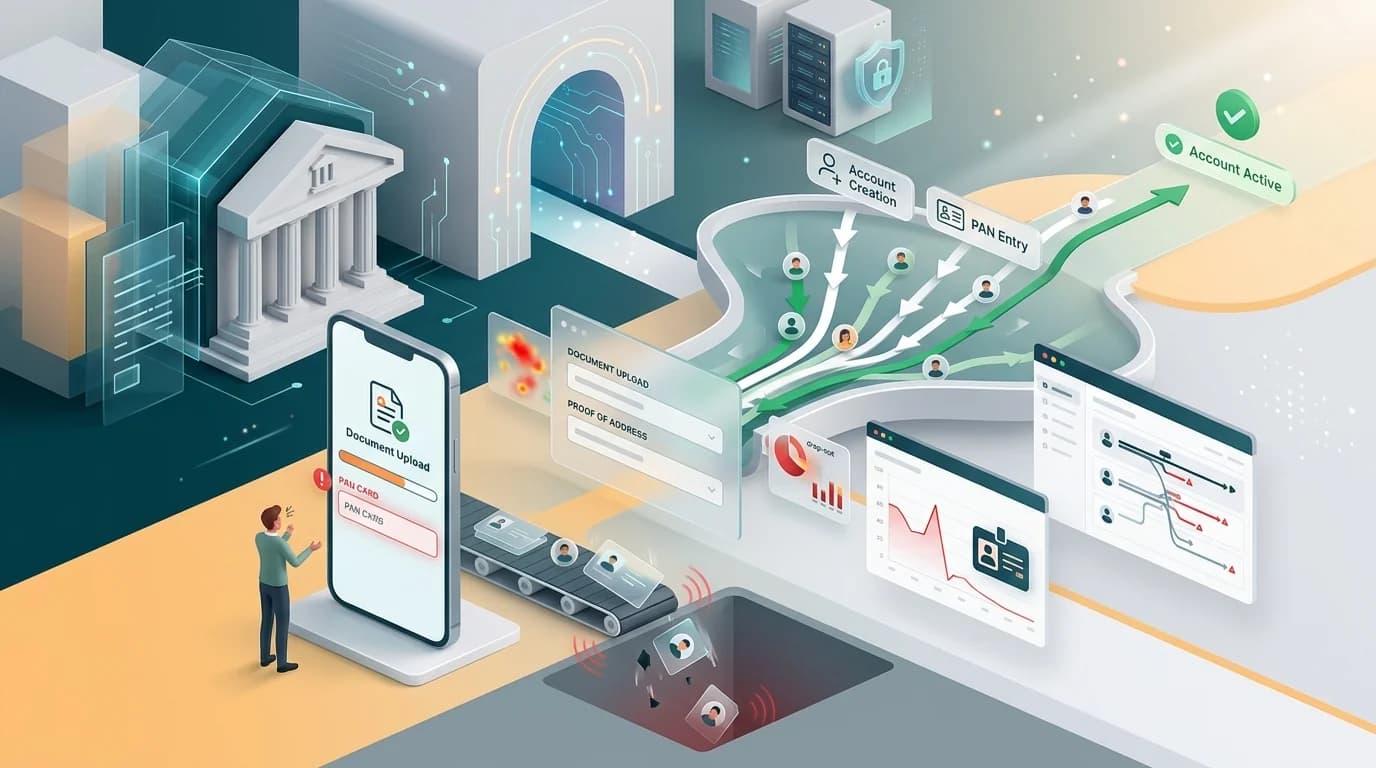
A user lands on your neobank homepage at 11pm, taps "Open account," types their phone number, gets the OTP, and starts uploading their PAN. The image rotates sideways. The upload spinner runs for 40 seconds. Nothing happens. They close the tab.
You will never know this happened. Your analytics will show one more "drop-off at step 3." Your CRM will mark the lead as cold. The user will open a competitor's app the next morning.
This is the quiet bleed in fintech onboarding — and it happens at every stage of the lead-to-first-transaction funnel.
The four-stage funnel every fintech actually runs
Whether you're a neobank, a lending app, a stockbroker, or a payments wallet, the journey looks roughly the same:
- Lead capture — phone, email, or social signup
- KYC — PAN, Aadhaar, address proof, selfie liveness
- Verification — bank account penny-drop, video KYC, signature
- First transaction — funding the wallet, placing the first trade, signing the loan agreement
Industry benchmarks for digital banking onboarding put end-to-end completion in the 25–35% range. That means roughly 7 out of every 10 people who start an account never fund it. A funnel view of those four stages is the only way to see which stage is killing you on any given week.
Most fintech teams stitch this together from event analytics — Mixpanel, Amplitude, GA4. You get the numbers. You don't get the why. And in a regulated industry where compliance teams have to sign off on every form change, the why is the only thing that lets you ship a fix.
Stage 1: Lead capture leaks before the form even loads
Lead capture forms in fintech look simple — phone number, OTP, maybe an email. The drop-off here is usually under 10%, which everyone treats as "fine."
It isn't fine. The leaks here are silent and they compound.
A common one: the OTP SMS takes 90 seconds because the team is using a budget gateway, and impatient users on Jio close the tab before it arrives. A heatmap of that screen shows users tapping the "Resend OTP" button two and three times — a clear signal the latency is killing the funnel before it even starts.
Another: the consent checkbox for DPDP/GDPR is below the fold on small Android screens, and the submit button is greyed out. Users don't know why. They leave.
The fix usually isn't a redesign. It's seeing a session recording of three angry users on a 5.5-inch screen mashing the disabled CTA, then moving the checkbox above the button.
Stage 2: KYC is where 30–40% of fintech funnels die
If your funnel has one cliff, it's here.
The pattern repeats across the industry:
- PAN entry works fine — text input, low friction
- Aadhaar OTP works fine when the UIDAI server is up
- Document upload is where everything falls apart
Document upload fails silently on mobile more often than any other step in fintech onboarding. The phone's camera returns a 12MB image. The form rejects anything over 5MB but the error toast disappears in 1.5 seconds. The user re-tries with the same image. Same silent failure. They give up.
We wrote a deeper teardown of this exact problem in recover fintech loan and KYC forms lost at document upload — the gist is that without session replay tied to the funnel step, you cannot tell whether the user got a backend rejection, a frontend size cap, or simply timed out.
A funnel view that shows "started document upload → 100, completed → 47" tells you something is wrong. Pulling the 53 replays of users who started but never completed tells you what is wrong — and lets the compliance-bound team ship a one-line fix instead of a redesign that has to go back through legal.
Stage 3: Verification is where trust signals matter most
By the time a user hits video KYC or penny-drop verification, they've already handed over PAN and Aadhaar numbers. The drop-off here is usually 15–20%, and it's almost entirely about trust and friction — not technology.
The friction part is mechanical. Penny-drop fails when the user mistypes the IFSC. Video KYC fails when the agent is busy and the queue says "estimated wait: 12 minutes." Both are visible in funnels the moment they spike.
The trust part is harder. Users hesitate at the moment they're asked to authorize a bank account verification. They scroll up looking for the RBI license number, the SSL padlock, anything reassuring. If those signals aren't visible at that exact moment, they bail.
A heatmap of the verification screen will show you whether users are scrolling back up — a behavior almost no event analytics tool will flag. If they are, your trust copy is in the wrong place.
Stage 4: First transaction — the funnel's quietest killer
Industry data suggests 20–30% of fully verified neobank accounts never see a first deposit. Users finish onboarding, get their welcome screen, and then disappear for 60 days.
This stage is rarely instrumented as part of the funnel because it sits in a different product surface — the dashboard, not the signup flow. But it's where the lifetime value is made or lost.
The funnel here is short: dashboard view → "fund account" tap → amount entry → UPI/netbanking selection → confirmation. Drops between "amount entry" and "UPI selection" usually mean the minimum-deposit copy is unclear, or the user hit a cognitive wall and decided to "do it later."
Lead recovery on this stage is unusual but valuable — a user who entered an amount but didn't confirm is a much warmer prospect than a cold email list, and a 24-hour follow-up nudge with their saved amount pre-filled converts at multiples of generic re-engagement campaigns.
What "fixing the funnel" actually looks like
A mid-sized lending app we've seen go through this audit found three things in two weeks:
- 18% of loan applications were dying at income-proof upload — same silent file-size cap as the PAN problem
- 11% of users on Safari iOS couldn't get past the consent screen because of a third-party cookie issue (worth reading find mobile-only website bugs your QA never catches)
- 9% of fully verified users never funded because the "minimum ₹500" copy was below the fold on small screens
Three fixes. No redesign. Funnel completion went from 28% to 41% in the next 30-day cohort. None of those fixes would have been visible in event analytics alone — every one of them required watching real users hit the wall.
The takeaway
Fintech onboarding isn't a single funnel — it's four stitched together, and every one of them has its own failure mode. PAN entry doesn't fail the way verification fails, and verification doesn't fail the way first deposits fail.
Stop optimizing the form. Start watching the stage. Pull the replays of the users who didn't make it through, look at where their thumbs hesitated, and fix the one thing that actually broke. The fintechs winning at conversion right now aren't the ones with the prettiest signup flows — they're the ones who can see exactly where the next user is going to bail, and ship a fix before the cohort closes.
If you want to benchmark where you stand, the 2026 form abandonment benchmarks are a reasonable place to start. But the number that matters isn't the industry average. It's the gap between what your funnel completion is today and what it could be once you actually watch the bleed.