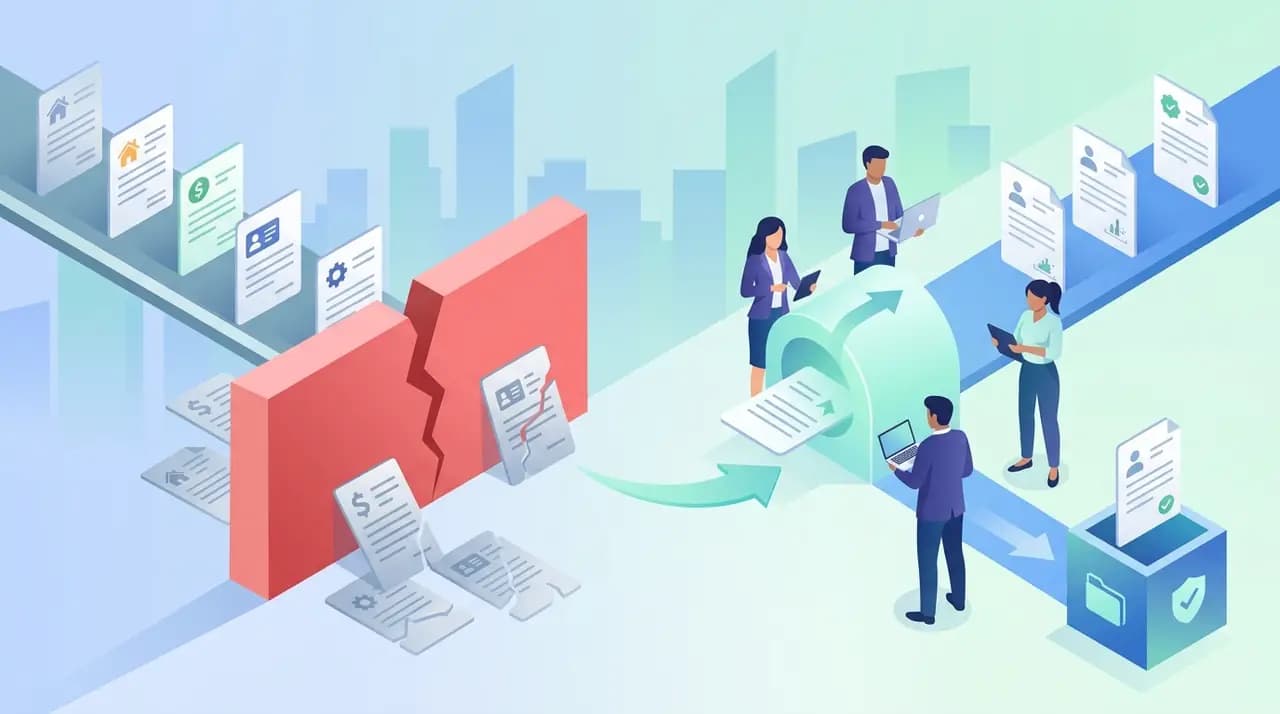
A user uploads their PAN card. The page hangs. They retry. The image fails again. They close the tab.
That's a ₹50 lakh personal loan, gone. And nobody on your team will ever know it happened — your funnel just shows a drop at "step 4."
Document upload is where most fintech onboarding flows quietly hemorrhage qualified leads. People who clicked your ad, picked a product, agreed to share their PAN and Aadhaar — and then disappeared because a 4MB JPEG wouldn't compress on a low-end Android.
Why fintech forms die at the document upload step
The pattern is brutally consistent. Account-opening and loan-application flows lose between 60% and 75% of starters before submit, with the steepest drop happening at identity verification.
A few reasons it happens:
- Mobile-first reality, desktop-first testing. Over 80% of KYC submissions in India come from mobile, but most QA happens on broadband desktops. A camera capture that works flawlessly on an iPhone 15 silently times out on a three-year-old budget Android.
- Silent failures. The upload widget shows a spinner. The spinner spins forever. No error toast, no retry prompt, no logged event in your analytics.
- File-size and format chaos. Your back-end requires under 2MB JPEGs. The user uploads a 7MB HEIC from their iPhone. Your front-end says "uploading…" and never recovers.
- Trust gaps at the worst possible moment. Right when users are about to hand over PAN, Aadhaar, or bank statements, your form looks like every phishing page they've been warned about.
Your standard analytics stack — Mixpanel events, GA funnels, even server logs — will tell you that drop happened. None will tell you why a specific user dropped, or how to bring them back.
The workflow gap
Here's the typical fintech ops workflow when a loan application stalls:
- The user starts the application.
- The user reaches the document upload step.
- The user fails silently.
- Your CRM shows a half-baked record, often without contact info if email and phone came after the upload step.
- Marketing sees the drop in the funnel report on Monday and shrugs.
- The user goes to a competitor.
If contact details were captured before the failure point, you might get a remarketing email out 48 hours later that says "Complete your application." It will not work, because you do not know why they stopped.
This is the gap lead recovery is built to close.
What lead recovery actually does for KYC and loan flows
CloseTrace records field-level interaction and friction metrics for eligible forms. When the active workspace policy permits supported fields, form drafts can also retain approved values before the final submit. Sensitive identity, payment, and authentication fields remain excluded.
For a fintech onboarding flow that means:
- The user enters their name, mobile, email, employer, and monthly income on steps 1–3.
- They reach the document upload step on step 4. The upload silently fails.
- They close the tab.
- You have a draft of their application in your dashboard with their full contact info, the exact step they reached, and a session replay showing the upload widget hanging.
Now your reactivation playbook actually has fuel:
- Outreach within 30 minutes, not 48 hours. Shorter gap, higher recovery rate.
- Specific message ("we noticed your PAN upload didn't go through — try this WhatsApp link"), not a generic nudge.
- A working alternative path — WhatsApp document collection, a callback from a relationship manager, or a desktop link sent by SMS.
Teams running this loop on loan flows report recovery rates between 8% and 14% of abandoned applications. On a flow doing 5,000 starts a month with a 65% drop, that is 260 to 455 recovered applications you would otherwise have lost entirely.
Compliance is the part nobody wants to talk about
Fintech is the one industry where "just record everything" is illegal. PCI-DSS, RBI guidelines, GDPR, and India's DPDP Act all draw hard lines around what you can capture, store, and replay.
Field-level masking has to be the default. PAN numbers, Aadhaar numbers, card numbers, OTPs, and CVVs should never leave the user's browser as raw text. Your team should see that the user typed something in the PAN field and whether validation passed — never the actual digits.
A few practical compliance points worth checking before you roll any session capture tool out on a regulated flow:
- Confirm the vendor masks all sensitive inputs at the SDK level, not after upload.
- Document upload contents themselves should never be transmitted to the analytics tool — only the event of upload success or failure.
- Your DPA needs to name session replay as a sub-processor and your privacy policy needs to disclose it. We covered this in detail in Is session replay GDPR compliant?.
- Under DPDP, you need explicit consent for behavioral analytics on flows that include sensitive personal data. A passive cookie banner is not enough.
The point: recovery without compliance is a seven-figure regulatory bill waiting to happen.
Pairing replay with recovery to fix the root cause
Recovering individual leads is the short game. The long game is fixing the upload step so the leak shrinks.
That is where session recording earns its keep. Watch 20 abandoned sessions in a row at the document upload step and patterns surface fast:
- 60% are on a specific browser-version combo that silently fails the upload.
- 25% are tapping the upload button but never selecting a file because the file picker is hidden behind your sticky help widget.
- 15% upload successfully but bounce because the "verifying…" state takes 40 seconds with no progress indicator.
Each pattern is a different fix. None of them show up in funnel charts. A heatmap on the same step often confirms the click pattern that matches the failure mode.
What measurable looks like
A reasonable 90-day target for a fintech team putting this in place:
- Recovery rate of 10% on abandoned applications past the contact-capture step.
- Document upload completion up 15–25% after fixing the top two patterns surfaced in replay.
- Cost-per-funded-loan down 12–18% because you are converting traffic you already paid for instead of buying more.
The trick is treating the upload step as a product problem, not a marketing problem. Lead recovery gives you the second chance. Replay tells you what to fix so you need fewer second chances next quarter.
If your loan or account-opening funnel is bleeding at step 4 and you cannot tell why, start there. Pull 50 abandoned sessions, watch them at 4x speed, and count the patterns. The fix usually pays for the tool inside a month.