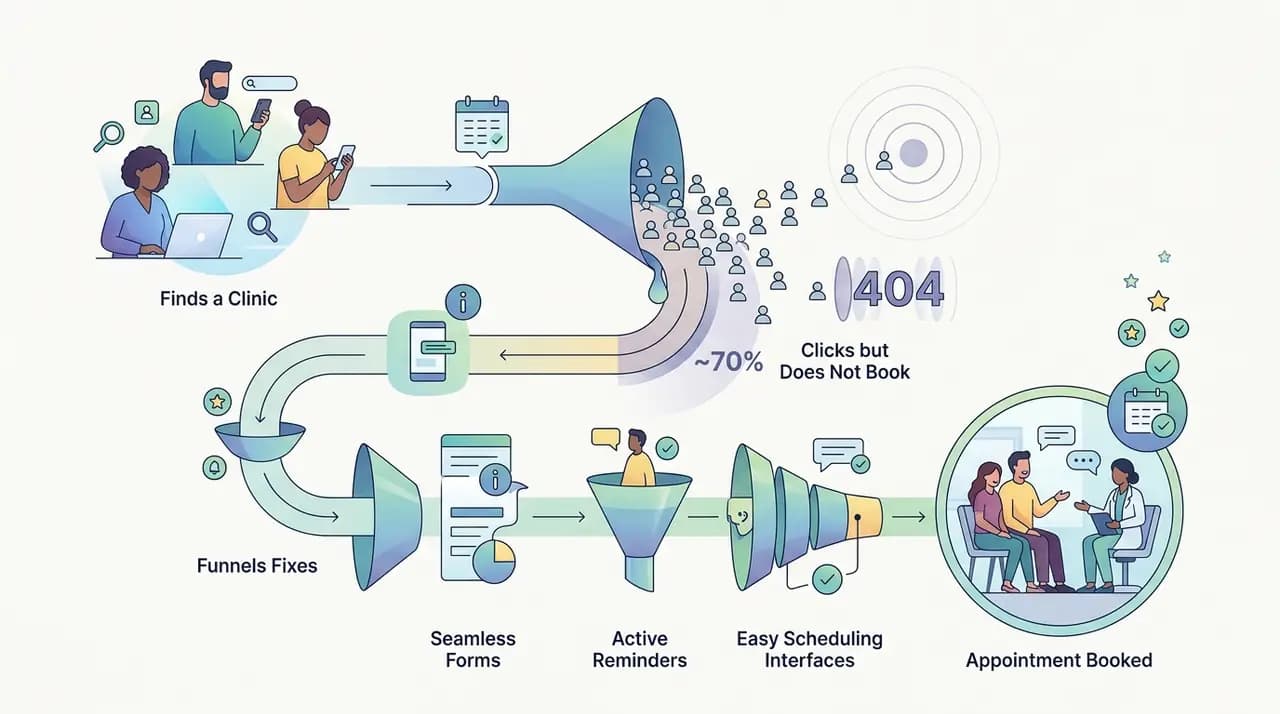
A clinic spends $4,800 a month on Google Ads, drives 1,200 clicks to its booking page, and walks away with 38 confirmed appointments. The marketing director shrugs and asks for more budget. The conversion rate is "normal for healthcare." Nobody opens the funnel report.
That's the problem. "Normal for healthcare" means over 70% of ad clicks never convert, and most clinics have no idea where in the funnel those visitors quietly disappear.
This is a guide to mapping that funnel — search to enquiry to confirmed booking — and finding the specific steps where your patients abandon you.
Why healthcare funnels break differently
Patients aren't shopping for software or sneakers. They're cautious, emotionally invested, and risk-aware. A funnel that works for SaaS or e-commerce will hemorrhage users in healthcare.
A few reasons specific to clinics and telehealth:
- Patient intake forms ask for 8-12 fields up front — name, DOB, address, insurance carrier, member ID, group number, primary care physician, reason for visit, preferred time, sometimes a photo of an insurance card. Aggressive validation rejects half of them on the first try.
- Time-slot pickers break on mobile. A two-week calendar grid that works fine on desktop turns into an unreadable swipe gesture on a 375px screen.
- Insurance-first flows scare people away. Asking for insurance details before showing a price or a slot tells the visitor this is going to be a fight.
- Telehealth signups demand too much PII before showing value. SSN, address, pharmacy of choice — all before the visitor has seen a doctor's face.
You won't find any of this in your ad platform. Google Analytics will tell you how many people landed on /book-appointment. It won't tell you they bailed at field 7 because the phone validator rejected the +1 prefix.
The patient journey, mapped as a funnel
Build the funnel with five stages. Each one corresponds to a real step a patient takes between seeing your ad and showing up for the appointment.
Stage 1 — Search to landing
Triggered when a patient arrives from organic search, paid ads, or a referral. Track the landing URL and the source.
What kills this stage: a landing page that looks like a hospital admin portal rather than a place to book care. If your hero says "Patient Portal Login" instead of "Book a same-day visit," your bounce rate will tell the story.
Benchmark: a healthy clinic landing page holds 65-75% of visitors past the first 10 seconds. Below that, your ad-to-landing-page message match is broken.
Stage 2 — Landing to enquiry
The visitor clicks "Book Now" or "Get Started." This is where most clinics start their actual booking flow.
This is also where insurance-first questions start hurting. If the second screen asks "What's your insurance carrier?" before the visitor has seen any time slots, expect 30-40% to bounce. The visitor doesn't know yet whether the clinic is even in-network or has availability — asking for insurance up front feels like a gate.
Stage 3 — Enquiry to slot selection
The visitor has filled out reason-for-visit and basic contact info. Now they need to pick a time.
This is the silent killer for mobile traffic. A funnel report that segments by device usually reveals desktop converting at 32% and mobile converting at 11% — the same flow, but the mobile time-slot picker is broken in ways desktop QA never sees.
Common mobile failures:
- Calendar grid that requires horizontal scroll
- Slots rendered as touch targets under 32px
- "Next available" defaulting to a date three weeks out with no easy way to change it
Stage 4 — Slot selection to intake completion
The visitor has picked a slot. Now the long intake form appears: insurance details, medical history, demographic data, consent checkboxes.
This is where 8-12 field forms collapse. Watch a session replay of a mobile patient at this stage and you'll see them tap, fail validation, scroll up, retype, fail again, and close the tab. They never reach the confirmation screen.
If your intake form is required before booking, split it. Ask only what you need to hold the slot. Collect the rest after the appointment is confirmed, ideally via secure email link the day before. For visitors who quit halfway, lead recovery can capture the email and phone they typed (never the masked PHI fields) so an intake coordinator can call them back.
Stage 5 — Intake to confirmed booking
The final submit. Card on file or insurance verification, then a confirmation screen.
Drop-off here is almost always a server-side or trust failure: the spinner runs for 8 seconds, the card declines without explanation, or the confirmation email never arrives. A heatmap of the confirmation page tells you whether visitors are scrolling looking for proof their booking worked.
What a real funnel looks like in numbers
A pediatric urgent-care clinic running paid search, one month:
| Stage | Visitors | Conversion |
|---|---|---|
| Search → Landing | 1,200 | — |
| Landing → Enquiry | 540 | 45% |
| Enquiry → Slot pick | 310 | 57% |
| Slot pick → Intake | 142 | 46% |
| Intake → Confirmed | 38 | 27% |
The biggest leak is the last step — only 27% of visitors who start the intake form finish it. That's where the 8-field minimum lives. Cut it to 4 fields and reorder so insurance comes after slot confirmation, and that 27% typically jumps to between 55% and 60%. Same ad spend, 75-80 bookings instead of 38.
You can't see any of that without the funnel view. Google Analytics shows a single goal completion rate. It doesn't show you the stage-by-stage decay.
HIPAA and GDPR — what to mask
Mapping the funnel doesn't require capturing PHI. Any session capture or replay tool used in healthcare needs default masking on form inputs that may contain protected health information: name, DOB, SSN, insurance numbers, medical history.
CloseTrace lets you tag specific selectors as sensitive so their values never leave the visitor's browser. The funnel itself only needs to know which step the visitor reached, not what they typed. For a deeper dive on what's allowed under EU rules, see is session replay GDPR compliant.
The practical takeaway
If you only do one thing this week: build the five-stage funnel above with whatever tool you already have, segment by mobile vs desktop, and find your single worst stage. That stage is your one-thing-to-fix.
Don't redesign the whole booking flow. Don't argue about the hero copy. Find the step where a third or more of patients vanish, and rewrite that step until they don't.
Then run the funnel report again next month.