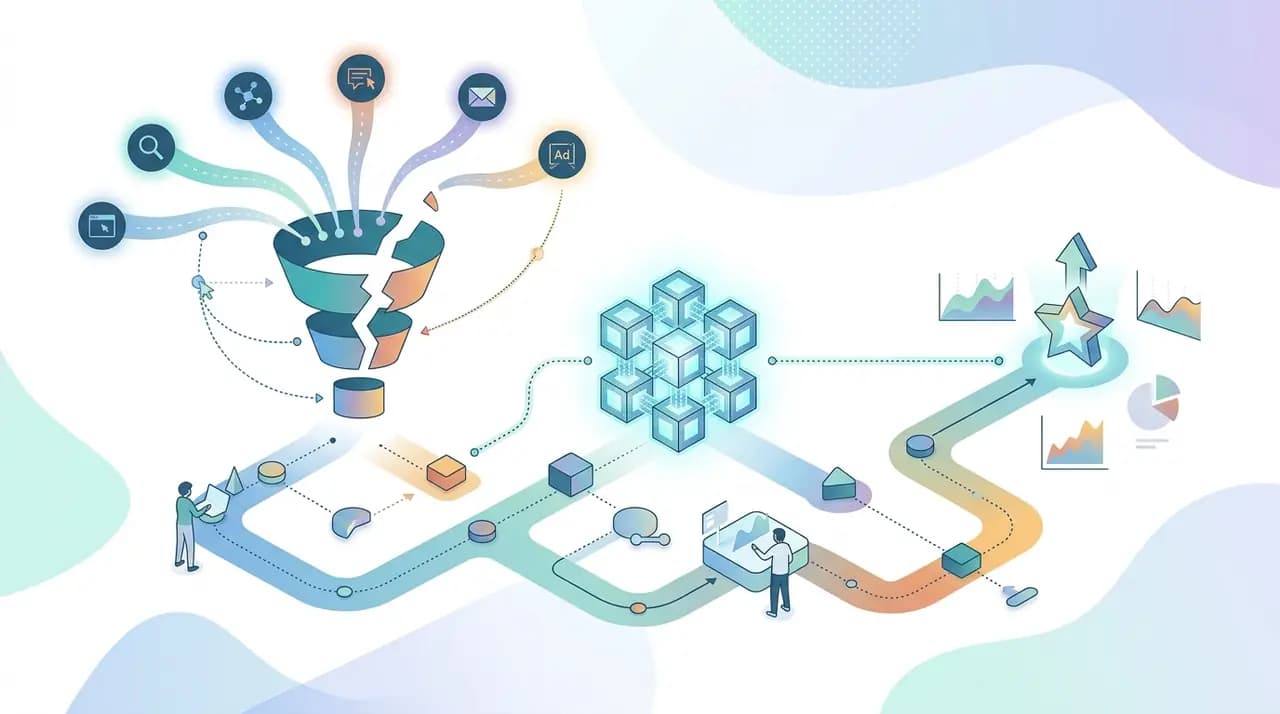
Here's a number that should make every SaaS marketing leader wince: 73% of B2B marketers can't accurately connect their campaigns to closed deals. Not "struggle to." Can't. And when your sales cycle runs 4-6 months across 6-10 decision makers, last-click attribution isn't imperfect — it's actively lying to you.
The real cost? Research across 500+ SaaS companies pegs the average attribution-related misallocation at $50K+ per year. Companies with solid attribution grow roughly 20% faster and waste about 40% less budget than the ones flying blind.
So why do so many of us keep flying blind?
Attribution doesn't break because you picked the wrong model
Every attribution guide on the internet opens with the same tired lineup: first-touch, last-touch, linear, time-decay, U-shape, W-shape, data-driven. Pick one. Ship it. Problem solved.
Except that's not where attribution actually falls apart.
Attribution breaks because four things quietly drift out of alignment:
1. Every platform is optimized to claim credit. Google Ads says it drove the conversion. LinkedIn says it drove the conversion. HubSpot says it drove the conversion. If you add up what every tool reports, your pipeline looks 3x larger than it actually is. These platforms aren't neutral — they're scored on the credit they can claim.
2. Long sales cycles destroy simple stories. A prospect who hit your site in January, watched a webinar in March, got re-targeted in May, and closed in August has a journey that no 30-day attribution window can capture. By the time the deal closes, the cookies are gone, the session IDs have rotated, and half the touchpoints live in systems that don't talk to each other.
3. Definitions drift across teams. Marketing's "qualified lead" isn't sales' "qualified lead." RevOps' "pipeline" isn't finance's "pipeline." When the VP of Marketing reports one number and finance shows another in the board deck, nobody's arguing about reporting anymore. They're arguing about reality.
4. Nobody owns the confidence level. Every attribution report comes with an implied "this is true." Almost none come with "here's how sure we are and where the gaps live." That missing confidence layer is what turns attribution into a political weapon instead of a decision-making tool.
What good-enough attribution actually looks like
Stop trying to prove every touchpoint. You won't. The goal isn't scientific precision — it's explaining how demand becomes pipeline and revenue well enough for leaders to make decisions they trust.
That's it. That's the bar.
Start with a different question than "which model should we use?" Start with: what decision does this company need attribution to support next?
- "Should we double down on paid search or shift budget to content?"
- "Is the LinkedIn spend actually producing enterprise pipeline?"
- "Which landing pages convert qualified traffic vs. tire-kickers?"
If the decision is vague, the attribution project sprawls. If the decision is clear, the work shrinks to something you can ship in a quarter instead of a year.
The gap your CRM won't show you
Here's where most SaaS attribution stacks fall down: they measure what happened in the CRM — form fills, demo bookings, closed-won — but miss what happened on the page that led to those events.
You know the campaign drove 500 visitors. You know 12 filled out the form. You don't know:
- How many started the form and bailed at the phone field
- Which pricing tier users hovered on before closing the tab
- Where high-intent visitors rage-clicked because something didn't load
- Which campaign source produced users who actually engaged vs. bounced
That's a massive attribution gap. And it's the one gap that tools like Salesforce, HubSpot, and Google Analytics structurally can't fill — because they only see events, not behavior.
This is exactly where session replay and funnel analytics earn their keep. Replay shows you the full path a user took from landing page to bounce — or to form submit. Heatmaps show you where attention pooled on the pages your campaigns drove traffic to. And lead recovery catches the prospects who started filling your form but quietly left — the ones your attribution model will never count because they never became a "lead" in the first place.
If form abandonment on your highest-intent landing pages runs 60-80% (industry standard for B2B SaaS), your attribution model is congratulating you on the 20% you closed while ignoring the 4x larger cohort that ghosted. Fix that, and suddenly your "underperforming" channels might be your best ones.
The 80/20 stack for mid-size SaaS
You don't need a $300K attribution platform to do this well. A mid-size SaaS team can cover 80% of the decisions that matter with four layers:
- UTM hygiene that actually gets enforced. One naming convention. One source of truth. Kill the dropdowns that let reps freestyle campaign names.
- CRM-side multi-touch at the account level, not the contact level. B2B is an account sport.
- Behavior-layer truth — a tracker that captures what users actually did on the site, not just what they submitted. Compare this with tools like Hotjar or Microsoft Clarity depending on your stack and privacy posture.
- A quarterly reality check where marketing, RevOps, and finance sit in one room, agree on definitions, and publish one number. No parallel dashboards.
That's it. That's the playbook. You can bolt on data-driven attribution models later, but without those four layers, the fancy model is just a prettier lie.
The takeaway
Attribution isn't a measurement problem. It's a trust problem wearing a measurement costume.
Pick one decision your attribution needs to support this quarter. Clean up the data that informs that decision. Layer in behavioral data so you see the silent 60-80% of high-intent traffic your CRM never logs. Publish one number, with a confidence level attached.
Do that, and you'll make better calls with less data than most teams make with ten times the stack. Try CloseTrace free if you want to see what your attribution is currently missing — pricing starts where most teams already spend on tools they barely use.