A serious buyer just spent fourteen minutes on your three-bedroom listing in Whitefield. They opened every photo, expanded the floor plan twice, scrolled the neighbourhood map, watched the virtual tour to the end. Then they closed the tab.
No enquiry. No callback request. No name in your CRM.
If you're like most real estate teams, you'll never know that visit happened, because your reporting only counts the leads that came through. The 97 buyers who almost enquired today? Invisible. And that's the gap that quietly decides whether your monthly closings hit target or miss by half.
The four-stage funnel real estate teams keep skipping
Most real estate websites measure two numbers: traffic and leads. Sometimes a third — closings. Everything in between gets reported as "we need more leads" in the Monday meeting.
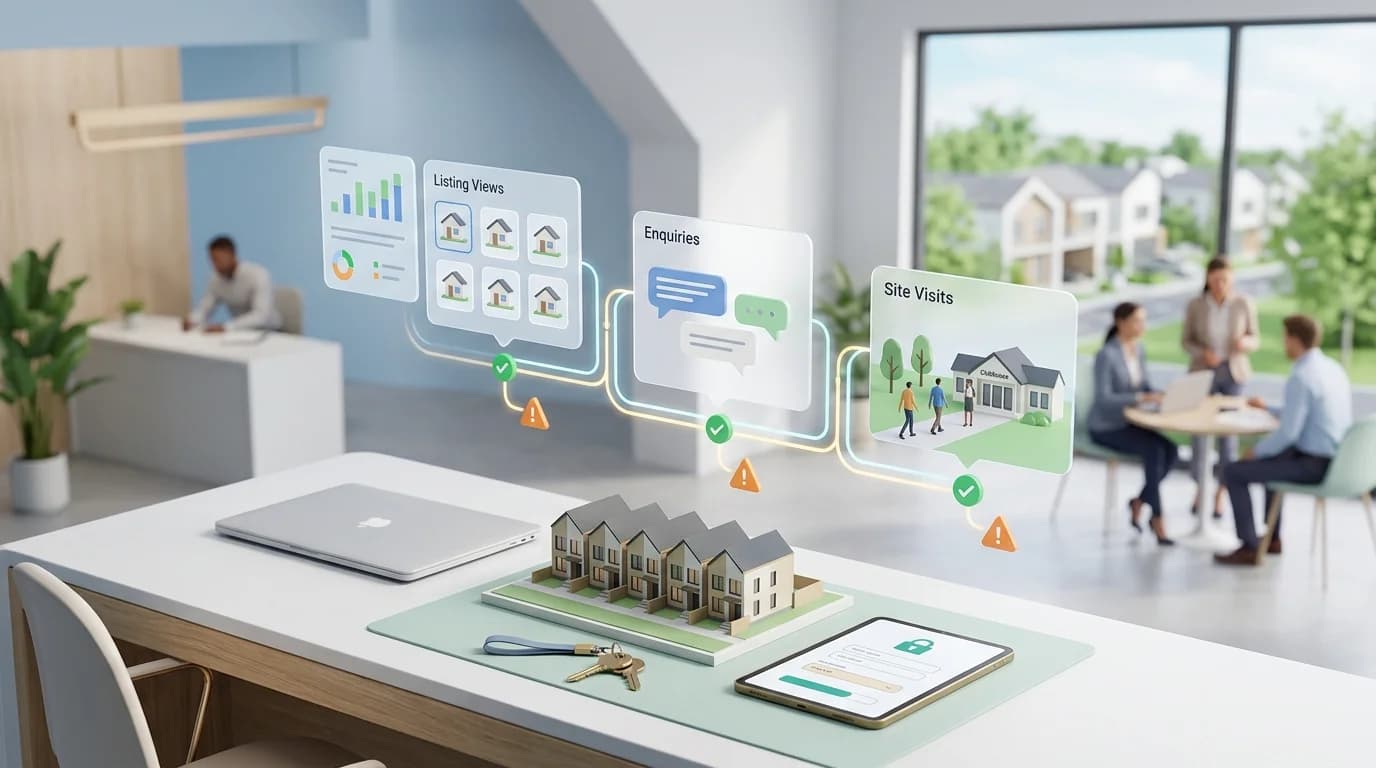
But the buying journey for any property — resale flat, new launch, plot, villa — has at least four stages on the digital side:
- Listing view — buyer lands on a property detail page
- Enquiry submitted — buyer fills the contact form, books a callback, or starts a chat
- Site visit booked — buyer agrees to a physical visit (or virtual walkthrough with an agent)
- Token paid — buyer commits with a token amount or booking fee
Every stage has a drop-off rate. And every drop-off has a reason. If you're only reporting "we got 240 leads this month, 18 site visits, 4 token payments," you're describing the leak — not finding it.
A proper funnel view stitches these four steps together so you can see exactly where buyers fall through. And it's almost always somewhere different from where your sales team thinks it is.
Stage 1 → 2: Listing view to enquiry submitted
This is where the bleed is biggest. A healthy real estate listing page converts somewhere between 1% and 3% of views into enquiries. Which means 97 to 99 out of every 100 buyers you paid Google to send you walked away without leaving a name.
There are usually three reasons:
The form asks for budget too early. A buyer browsing a 2.4 crore apartment may not want to commit to a budget bracket on the first interaction — especially if they're stretching. The moment a "Budget" dropdown appears on enquiry form step one, serious buyers self-select out. We've covered this pattern in detail in real estate lead recovery: saving buyers who bail at budget.
Image carousels break on mobile. If 65% of your traffic is mobile and the swipe gesture stalls on the third photo, you'll see a spike of rage clicks and a dead listing. Heatmaps make this obvious in a single glance — a cluster of red dots over a non-responsive arrow tells the whole story.
Virtual tour engagement that never converts. Buyers spend three minutes inside a 3D walkthrough, then exit. There's no clear "Book a site visit" prompt at the moment of peak interest, so the engagement evaporates. Session replay catches this every time — you watch the buyer reach for a CTA that isn't there.
The fix isn't always a redesign. Often it's removing one field, replacing one CTA, or fixing one carousel. But you need the funnel to tell you which.
Stage 2 → 3: Enquiry submitted to site visit booked
This is the conversion that decides whether your sales team has a real pipeline or a list of cold names.
Industry benchmarks put enquiry-to-site-visit conversion somewhere between 15% and 30% — and the variance is mostly about how fast you respond and how qualified the lead is. If your sales team is calling 50 numbers a day and 8 are agreeing to visit, you're in the normal band.
But here's where the funnel view matters: you can segment buyers by the journey they took before they enquired. Buyers who watched the virtual tour for over two minutes convert to site visits at roughly twice the rate of buyers who only scrolled photos. Buyers who opened the floor plan PDF convert higher still.
If you can see that segmentation in your funnel, you know which leads to call first. If you can't, your sales team is treating every enquiry the same — and burning the high-intent ones with the same follow-up cadence as the tyre-kickers.
This is also where form drafts and lead recovery earn their keep. A buyer who started filling the enquiry form, typed their name, and then bounced when the budget field appeared — that's a recoverable lead, not a lost one. A short email with the listing photos and a "no budget needed" callback offer recovers a measurable share of these.
Stage 3 → 4: Site visit booked to token paid
This stage feels like a sales problem, not a website problem. And mostly it is. But two digital touchpoints quietly affect it.
Mortgage calculator pages with no clear next step. A buyer leaves the site visit excited, goes home, opens your EMI calculator, plays with numbers — and then there's nowhere to go. No "Talk to our home loan partner" CTA, no "Reserve this unit for 48 hours" option. The momentum dies in the silence.
Documentation pages that look intimidating. If your "Booking process" page lists 14 documents in a wall of text, buyers stall. Watching a few session recordings of buyers on this page usually reveals the same pattern: scroll, scroll, back button.
A well-built funnel shows you the conversion rate from "site visit booked" to "token paid" by source, by listing, by sales agent. The variance across agents is often shocking — one agent converts site visits to tokens at 22%, another at 6%, on the same listings. That's a coaching problem, not a marketing problem, but you only see it when the funnel hands you the numbers.
What changes when you watch the whole funnel
Real estate teams that switch from "leads in, deals out" reporting to four-stage funnel tracking usually find one or two specific drop-off points that account for most of the loss. Fixing those — a form field removed, a CTA added after virtual tours, a faster callback for high-intent enquiries — often lifts site-visit bookings by 15-25% without spending more on ads.
Privacy obligations matter here, especially for international buyers and NRI traffic. CloseTrace applies replay privacy controls before upload; you can read more about the surrounding controller obligations in is session replay GDPR compliant. Indian deployments should run the same notice, consent, and data-minimisation review under the DPDP Act.
The practical takeaway
Pick one listing — your highest-value or highest-traffic one — and map the full four-stage funnel for it this week. Listing views, enquiries, site visits booked, tokens paid. Calculate the drop-off at each stage. Then watch ten replays of buyers who dropped off at the biggest leak.
You'll have a fix list by Friday. And it'll be specific, evidence-backed, and almost certainly cheaper than the next round of Google Ads.