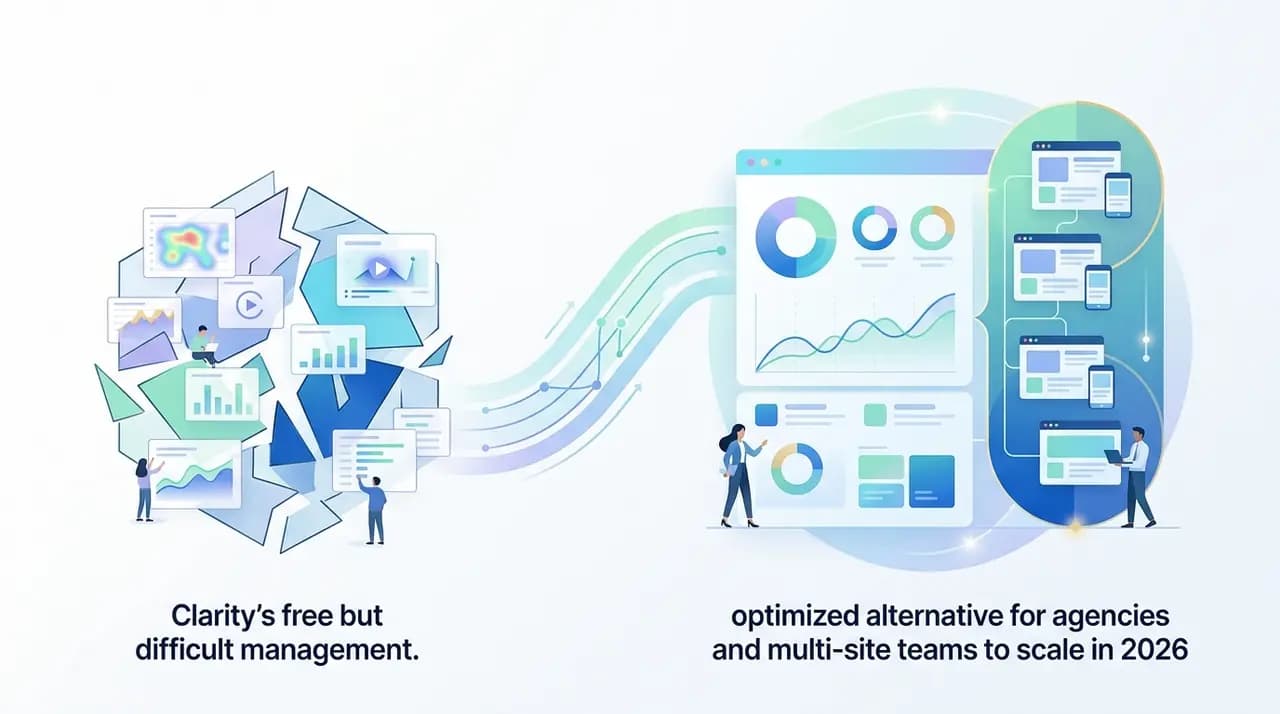
Clarity is free. Unlimited sessions. No credit card. So why are agency teams and multi-brand marketers quietly paying for something else?
The answer isn't features. It's friction.
Once you move past a single site, Clarity starts feeling like a consumer tool borrowed for a professional job. Separate dashboards per property, no proper role management, no way to share a single view across clients or brands, and zero way to tie session behavior back to the lead that actually matters. For a solo founder, fine. For a team running eight landing pages across four brands, it becomes death by browser tabs.
This post is for the second group.
Where Clarity quietly stops working
The limitations aren't hidden. Clarity's own docs are honest about the scope: it's a website behavioral tool. No mobile SDKs. No built-in funnels. No retention cohorts. No lead-level attribution. No self-hosting. All data sits on Microsoft infrastructure, and support is community-only.
None of that matters if you're validating a new landing page. All of it matters if you're running growth for a portfolio of sites.
The bigger operational problem is multi-site management. Clarity gives you a project per site, and that's basically it. There's no concept of a workspace, no granular team permissions that survive handoff between agency and client, no unified heatmap view across a brand family. Every new site is another project, another invite thread, another login ritual.
According to recent comparison roundups, the most consistent user complaint isn't pricing (there is none) — it's that Clarity can't grow with a team. The feature set is frozen because there's no paid tier funding new development.
What "multi-site team management" actually requires
If you're evaluating alternatives with a team in mind, these are the questions to ask. Most tools answer two or three. Very few answer all five.
1. Can one workspace hold many sites? Not many projects sharing a login. One workspace where sites, recordings, heatmaps, and funnels roll up into shared dashboards.
2. Can roles be scoped per site? Your SEO contractor should see one client's data, not all of them. Your designer needs replay access but not billing. Clarity can't do this cleanly.
3. Does session data connect to the lead? This is the big one most tools miss. Watching a session is interesting. Knowing that this specific anonymous visitor became a form submit — or abandoned — is what actually ships revenue.
4. Can the team annotate and share clips? If every insight dies in someone's Slack DM, it may as well not exist.
5. Does pricing scale by usage, not seat count? Per-seat pricing punishes collaboration. Five-person teams end up with one shared login, which defeats the point of team management in the first place.
The honest tradeoffs across the usual suspects
Hotjar is the grandparent of the category. Good heatmaps, clean replays, but it was designed for single-site workflows. Multi-site management exists but feels bolted on, and pricing gets expensive fast once you add sites.
FullStory is the enterprise answer. Proper workspace management, deep segmentation, serious pricing. If you're running growth for a Fortune 500, this is fine. If you're an agency managing ten clients, the contract conversation alone will take longer than the implementation.
Smartlook sits in the middle — mobile SDKs, decent replay, but team management is thin and the lead-level attribution story is basically absent.
PostHog and UXCam are product-team tools. They're powerful, but they're built for engineers querying events, not marketers watching a visitor fill out a contact form. The learning curve is real.
And Clarity, to be clear, is still excellent for what it is. If you run one site and just need to see where people click, keep using it.
What we built differently at CloseTrace
CloseTrace started from a specific frustration: marketing teams were watching session replays, spotting a visitor abandon a form, and then having no way to recover that lead. The session was anonymous. The form data was gone. The only thing left was frustration.
So we built around the lead, not the session.
Every session replay in CloseTrace stays tied to its captured session. When an eligible form is abandoned, Lead Recovery preserves field-level behavior and, where the workspace capture policy permits supported contact fields, surfaces those values in a recovery queue. That is the workflow Clarity does not provide as a first-class feature.
On the multi-site side, the tracker installs once per site and all sites can live in one organization. Each site has its own key and site-scoped heatmaps, funnels, sessions, and recovery data. Organization admins and users have different capabilities, but the current release does not provide per-site membership restrictions inside one organization.
Hosted access is free during early access; public billing and enforced plan limits are not live yet. See pricing for the current status.
A practical migration path
If you're moving from Clarity, don't rip and replace. Run them in parallel for two weeks.
Install CloseTrace alongside Clarity on your highest-traffic landing page. Watch for two things: whether your form abandonment data shows recoverable leads Clarity was missing, and whether your team actually uses the shared workspace instead of reverting to screenshots in Slack.
If those two behaviors stick, migrate the rest of your sites. If they don't, Clarity was probably enough for your stage.
One more thing worth checking before you commit to any replay tool: GDPR compliance posture. Clarity handles this well by default; not every alternative does.
The takeaway
Free is the strongest feature in software, and Clarity will keep winning single-site users because of it. But if you're running a team across multiple sites and your real question is "which anonymous visitor just became a lost lead" — that's a different tool. Pick the one that answers your actual question, not the one with the lowest sticker price.